English
If you are shopping for a P2.97 indoor LED video wall from China, here is the short version. P2.97 (often written P2.976) is the standard 500×500 mm die-cast aluminum rental pixel pitch with roughly 112,896 dots per square meter, best viewed from about 3 meters and beyond. Factory-direct pricing typically lands between USD 400 and 900 per square meter for rental-grade cabinets, and closer to USD 300–700 per square meter for fixed-installation indoor panels, FOB Shenzhen. The manufacturers worth your time will send you a single working sample cabinet, show you a live aging test on video call, quote a line-item breakdown instead of one lump number, and hold CE plus RoHS (FCC or UL if you are in North America) with ISO 9001 on file. Anything cheaper than those ranges usually means recycled LEDs, thin PCBs, and a warranty that disappears after payment. Now let me walk through the details, because this is where most buyers get burned.
Honestly, half the people who ask me about P2.97 do not actually need P2.97. Let me clear that up fast.
P2.97 means the center-to-center distance between two pixels is 2.97 mm. In the industry you will see it written as P2.976 — same thing, just more precise. It sits right between P2.6 and P3.91, which makes it the default workhorse for indoor events: sharp enough that a camera does not pick up individual pixels at three to four meters, and cheap enough that a rental company can buy a lot of it.
Key numbers you can take to any supplier:
Pixel density: 112,896 dots/m² (module 250×250 mm, 84×84 pixels)
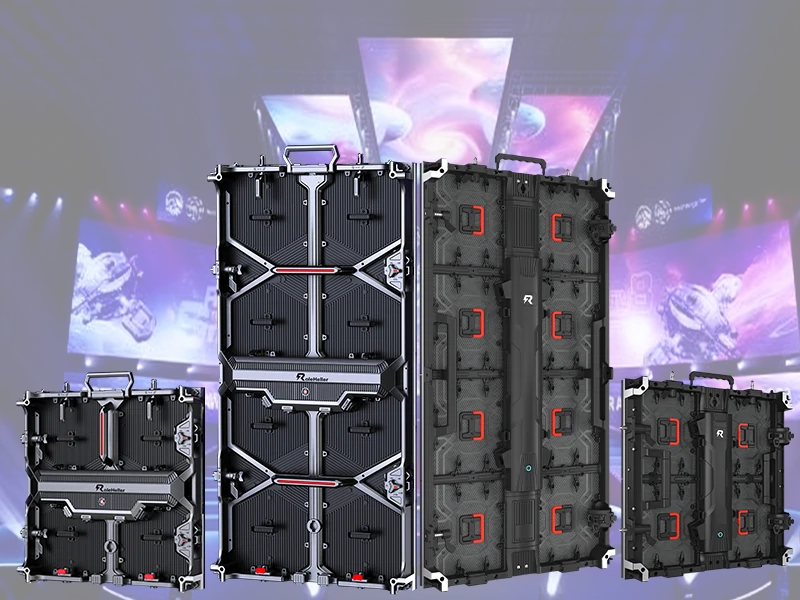
Cabinet sizes: 500×500 mm and 500×1000 mm, mixable on the same wall
Cabinet weight: around 7–8 kg, die-cast aluminum
Brightness: 800–1,500 nits for indoor use (do not let anyone sell you 5,500 nits indoors — that is an outdoor spec)
Refresh rate: 1,920 Hz minimum; insist on 3,840 Hz or higher if you are filming the screen
Viewing distance: comfortable from ~3 m onward; minimum usable around 2.9 m
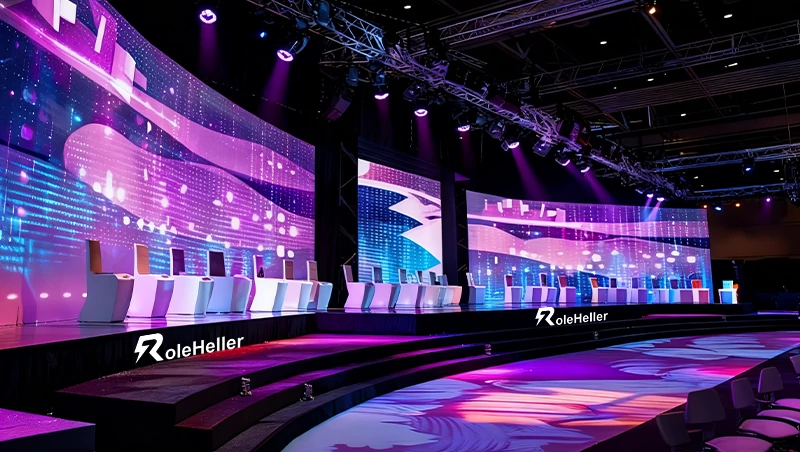
Who it is good for: trade show booths, church stages, wedding and event halls, concert backdrops, conference rooms where people sit more than four meters back, retail feature walls, and touring rental fleets.
Who should skip it: if your audience sits within two meters, go P1.8 or P1.5. If the screen lives outdoors or in direct sunlight through glass, you need IP65 outdoor rating, not IP30. If it is a 24/7 control room display, consider a fixed-install small-pitch panel rather than a rental cabinet.
This is the question everyone lands here for, so let me be concrete. Prices below are typical FOB Shenzhen ranges for standard configuration — Nationstar or Kinglight LEDs, meanwell-class power supply, Novastar control, die-cast cabinet. They do not include shipping, duties, controllers, or installation.
| Configuration | Typical Price (USD/m²) | Notes |
|---|---|---|
| Indoor fixed-install P2.97, standard cabinet | $300 – $700 | Cheapest route; heavier iron/steel cabinets common |
| Indoor rental P2.97, die-cast 500×500, 3840 Hz | $450 – $900 | The mainstream choice for events |
| High-refresh 7680 Hz, foggy black LEDs, copper wire | $800 – $1,400 | Broadcast and premium conference spec |
| Spare modules / power supplies (keep 5–8%) | $40 – $120 per piece | Non-negotiable for rental fleets |
| Flight cases | $150 – $350 each | Holds ~4–8 cabinets depending on design |
| Controller / receiving cards, processor | $300 – $2,500 per set | Often not included — ask explicitly |
A few things I have learned the hard way about these numbers:
The per-square-meter price is only about 60–70% of your real cost. Add controllers, flight cases, spare parts, crating, freight, duties, and local labor. I usually tell people to budget the screen at roughly two-thirds of total project cost.
Quotes that arrive instantly at the bottom of the range are not deals — they are bait. A serious factory needs your resolution, cabinet count, refresh rate, and controller brand before it can price properly. If someone quotes $280/m² in the first email without asking a single technical question, they are quoting a ghost product.
Volume tiers are real. Most factories will move 3–8% between a 20 m² order and a 100 m² order. Ask for the tiered price list upfront instead of negotiating each time.
Raw material costs move. LED chips, driver ICs, and PCBs fluctuate. A quote held for 7–15 days is normal; a quote held for 60 days at the same price means the margin is hiding somewhere else.
Suppliers love sending 40-line datasheets full of impressive numbers. Here is the shortened version I actually use when comparing quotes side by side.
| Parameter | What to Ask For | Why It Matters |
|---|---|---|
| LED brand/model | Nationstar / Kinglight SMD2121, ask for batch consistency report | Cheap LEDs shift color after 6 months; bin matching prevents patchy walls |
| Driver IC | MBI series or equivalent, 1/28 scan typical | Drives grayscale quality and low-brightness performance |
| Refresh rate | ≥3840 Hz (≥7680 Hz for broadcast) | Eliminates scan lines on phone and camera footage |
| Brightness | 800–1,500 nits, adjustable | Indoor rooms do not need outdoor brightness |
| Grayscale | 14–16 bit | Smooth gradients, no banding in dark scenes |
| Contrast ratio | ≥4,000:1, black face mask | Makes the image pop in lit rooms |
| Cabinet material | Die-cast aluminum, flatness tolerance checked | Keeps seams tight; warped cabinets ruin a seamless wall |
| Maintenance | Front and rear service | Ceiling-hung screens need front access — period |
| Certifications | CE, RoHS, FCC/UL, ISO 9001 | Customs and insurance care about these; you should too |
| Warranty | 2–3 years, with spare parts package and response time in writing | "3 years warranty" with no defined response process is worth nothing |
One thing that does not show up on any datasheet but matters enormously: ask for the aging test protocol. A decent factory runs every module through 48–72 hours of continuous aging plus grayscale and color calibration before packing. Ask them to film your specific cabinets during that test with your order number visible. If they hesitate, move on.
Shenzhen has thousands of LED businesses and a large share of them are traders wearing factory clothing online. I am not saying traders are bad — some are genuinely helpful — but you deserve to know who you are paying, because warranty claims go through them.
Here is my screening sequence:
Step 1 — Check the business license against the story. Ask for the Chinese business license and look at the registered name, establishment date, registered capital, and scope of business. A company founded last year claiming fifteen years of factory experience is lying. You can cross-check on public registries.
Step 2 — Ask for a live video walkthrough, not a pre-recorded tour. Say: "Can we hop on a video call at 3 PM your time and walk the production floor?" Then ask them to show you something specific — the SMT line, the aging room, your order's flight cases. Traders suddenly have scheduling problems.
Step 3 — Look at product focus. A real P2.97 maker sells LED displays and adjacent products. If the same store lists LED screens, solar lights, kitchen gadgets, and phone cases, it is a general trading account.
Step 4 — Verify certifications yourself. Ask for certificate numbers and issuing bodies, then check them on the issuer's website. Expired certificates, or certificates issued to a different company name, are extremely common.
Step 5 — Order one sample cabinet first. Yes, it costs more per square meter. Yes, it is worth it. Measure flatness, check seam gaps, run a full-white and full-black test, and leave it on for a week. This one sample will teach you more than twenty PDF brochures.
Step 6 — Start small, then scale. Put your first production order at a manageable size, confirm yield and on-time delivery, then grow. Every buyer I know who skipped this step has at least one container of regret somewhere.
Red flags I will not ignore: prices far below market, refusal to put warranty response times in the contract, no independent QC team, insistence on 100% payment upfront, and "our factory is next door" with no actual address.
These details kill more projects than bad pixels do.
MOQ: Most factories will do one square meter or even a single cabinet for sampling, but production pricing usually starts around 10–20 m². For a proper rental fleet you are looking at 40 m² and up.
Lead time: Standard is 20–30 working days including aging. Rush orders can sometimes be done in 12–15 days with a surcharge. If someone promises seven days on a 60 m² order, they are either pulling stock from another client or skipping the aging test.
Shipping: Screens ship in flight cases or plywood crates by sea LCL/FCL. Air freight is possible for urgent small orders but eats your margin. Confirm the HS code (8528.59 category) and your local duty rate before finalizing the budget. Ask for the packing list with dimensions and weights early so your freight forwarder can quote properly.
Payment terms: The industry standard is T/T 30% deposit, 70% before shipment or against copy of B/L. For larger orders, LC at sight is common. Never wire 100% upfront on a first-time relationship. Use a traceable method with the company name matching the business license — not a personal account.
Warranty in practice: A usable warranty clause names the response time (e.g., reply within 24 hours, replacement parts shipped within 5–7 days), states who pays freight on replacements, and includes a spare-parts package of 5–8% extra modules and power supplies shipped with the original order. I always ask for that spare kit included, not "available on request."
The church that bought too cheap. A congregation in Texas ordered the lowest-priced P2.97 they could find, roughly 25 m² for Sunday services. Six months in, they had visible color drift between modules because the LEDs came from different bins, and two power supplies failed during Easter service. They ended up buying a second batch from a different supplier and mixing cabinets was a nightmare. Lesson: keep all cabinets from the same production batch, and get the bin-matching commitment in writing.
The rental company that got it right. A mid-size event company in Germany started with a 30 m² sample order, verified flatness and seam gaps, then placed a 90 m² order with 8% spares and two extra flight cases. They specified 3840 Hz refresh and front/rear maintenance. Two years later they were still adding to the same fleet with no compatibility issues. Lesson: standardize your cabinet model and stick with it.
The trade-show exhibitor who over-specified. A brand insisted on 7680 Hz refresh and 16-bit grayscale for a 6×3 meter booth wall that nobody would film closely. It added about 35% to the cost. After seeing the render, they downgraded to standard 3840 Hz and spent the difference on better content. Honestly, good content beats marginal spec upgrades almost every time.
Ordering by price instead of by spec sheet. Two quotes at $600/m² can be completely different products. Compare line items, not totals.
Forgetting the controller. Novastar or Linsn systems, sending card capacity, and whether a video processor is included — this alone can add weeks if you discover it late.
Ignoring power requirements. A P2.97 wall can draw 600–800 W/m² peak. Venue electrical capacity is a real constraint and nobody tells you until load-in day.
Measuring the space wrong. Always confirm the exact buildable area, ceiling height, rigging points, and whether rear access exists. A screen designed for rear maintenance in a room with no back access is a very expensive problem.
Skipping the content plan. Pixel pitch determines how close people can stand. Design your graphics and camera angles around that, not the other way around.
No spare parts. Modules fail. Power supplies fail. Having them on site turns a two-hour fix into a twenty-minute fix.
If I were buying a P2.97 indoor video wall from China today, I would do this: shortlist three suppliers who can prove they actually manufacture, pay for one sample cabinet from each, run it hard for a week, then place a modest first order with the winner while keeping the runner-up warm as a backup. I would write the warranty response times and spare-parts percentage into the contract, and I would budget roughly a third extra on top of the per-square-meter price for everything else the project needs.
It is not the fastest path. It is the path that does not end with you staring at a dark screen the day before your event.
1. What does P2.97 mean?
P2.97 (also written P2.976) refers to a 2.97 mm pixel pitch. It delivers about 112,896 dots per square meter and is the most common indoor rental spec for events, stages, and conferences.
2. What is the best viewing distance for P2.97?
Comfortable viewing starts around 3 meters, with a minimum usable distance near 2.9 meters. If your audience is closer than that, consider P1.8 or P1.5.
3. How much does a P2.97 indoor LED video wall cost from China?
Expect roughly USD 300–700/m² for fixed-install panels and USD 450–900/m² for die-cast rental cabinets, FOB Shenzhen. Controllers, flight cases, freight, and duties are extra.
4. What is the difference between P2.6, P2.97, and P3.91?
Pixel density. P2.6 has about 147,456 dots/m², P2.97 has 112,896, and P3.91 has 65,536. Sharper images cost more. P2.97 is the middle ground that balances clarity and price.
5. Can P2.97 be used outdoors?
Only if it is built with an outdoor-rated cabinet, higher brightness (5,000+ nits), and IP65 protection. Standard indoor P2.97 is IP30 and will not survive rain.
6. What refresh rate do I need?
1,920 Hz is the bare minimum. Choose 3,840 Hz or higher if the screen will be photographed or filmed. Broadcast work often calls for 7,680 Hz.
7. How long does manufacturing take?
Typically 20–30 working days including aging tests. Rush production is sometimes possible in 12–15 days for a fee.
8. What is the minimum order quantity?
Samples can be a single cabinet. Production pricing generally starts around 10–20 m².
9. How do I verify a Chinese LED manufacturer is legitimate?
Check the business license and establishment date, request a live video floor walk, verify certificate numbers with the issuing body, examine product focus for signs of a trading account, and order a sample cabinet before committing to volume.
10. What warranty terms should I insist on?
Aim for 2–3 years with a written response time, clearly stated freight responsibility for replacements, and 5–8% spare modules and power supplies shipped with the original order.
.jpg "How to Choose OEM P3 LED Video Wall Manufacturers?")
.jpg "Where to Find Reliable LED Video Wall Manufacturers in India?")